Brain Test 2: Tricky Stories
- 4.7
- Rating
- 100.00M
- Installs
- Free
- Price
 Analysis by App-foxy
Brain Test 2: Tricky Stories is the kind of trivia game I open when I want something light but still mentally active. It is built around short riddles, visual puzzles, and story-led challenges rather than a traditional question-and-answer quiz. Some tasks look obvious at first, then turn on an unexpected detail, which is where the game gets its personality. I found it easy to start for a few minutes, although certain puzzles encouraged me to stay longer than planned because I wanted to understand the trick rather than simply guess.
Developed by Unico Studio, this free game sits in the casual trivia and brain-game space. It is rated for Everyone 10+, runs on Android 7.0 or later, and its current version is 1.20.43. The broad appeal is clear: the game has passed 100 million installs and holds a 4.8 average from around 1.7 million ratings, with roughly 16 thousand written reviews. Those numbers do not replace personal experience, but they do show that this is not a niche puzzle experiment.
What matters more to me is how the game feels in ordinary use. I can play it while waiting for an appointment, hand a puzzle to someone nearby, or use it as a quick change of pace after work. It does not demand the concentration of a long strategy game, yet it can still make me slow down and question the obvious answer. The best reason to try it is its playful approach to problem-solving, not its promise of serious training.
In-Depth Coverage of Brain Test 2: Tricky Stories
How the story puzzles shape the experience
I’ll focus on how the story framing changes the feel of each challenge, rather than treating the game as a standard quiz. That distinction also helps set realistic expectations: the puzzles reward careful observation and flexible thinking, while their quick, self-contained format makes them easy to pick up between other activities.
Short scenes instead of a standard quiz list
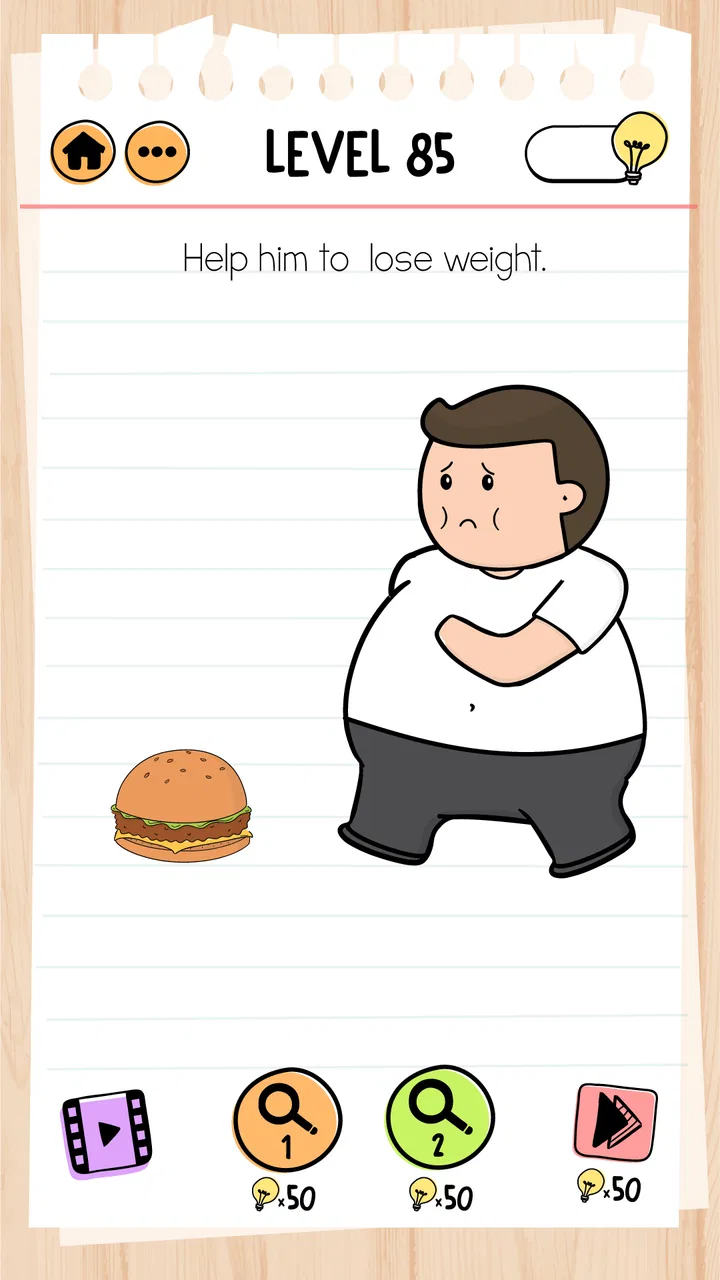
The story format gives the puzzles more character than a plain trivia database. Rather than moving through a wall of unrelated questions, I encounter situations that frame the challenge. That context helps the game feel like a sequence of small comic problems. The exact task can vary in spirit: sometimes I am looking for a visual clue, sometimes I need to interpret wording differently, and sometimes the intended action is less conventional than the first answer that comes to mind.
This structure is useful for casual players because every challenge has a clear local goal. I do not need to remember a large rule set from one session to the next. I can stop after a puzzle and return later without losing the basic rhythm. At the same time, the story framing does not turn the game into a deep adventure. The narrative mainly gives the riddles a setting and a reason to continue, so anyone looking for character development or a substantial plot should choose a different kind of game.
I also like that the puzzles invite discussion. When I get stuck, showing the screen to another person often produces a useful second interpretation. That makes it a good choice for a family setting or a relaxed conversation with a friend, especially for people who enjoy solving something together without committing to a long multiplayer session.
Why the obvious answer often fails
The central skill here is flexible attention. I have to examine the whole screen, read the wording carefully, and consider whether the expected interaction is different from a normal tap. This is where the game separates itself from ordinary trivia apps. A conventional quiz usually rewards stored knowledge; Brain Test 2 more often rewards noticing, experimentation, and willingness to challenge the first assumption.
That design can be satisfying when the solution becomes clear. A puzzle may initially seem unfair, but after I understand the intended trick, the answer can feel amusingly simple. The payoff is not just getting a fact right. It is recognizing how the game tried to steer my thinking in the wrong direction.
The same design can also create frustration. If I miss a tiny visual cue or interpret a sentence in the usual way, I may feel that I was tested on the game’s wording rather than on reasoning. That is an important distinction. Players who enjoy lateral-thinking riddles will probably accept this bargain, while players who want precise, knowledge-based questions may find the solutions arbitrary.
A practical way to play without wasting attempts
My most useful habit is to inspect the entire scene before tapping repeatedly. I look at the background, the characters, the objects near the edge, and the exact wording of the prompt. I then try the most natural action once before experimenting with less obvious interactions. This approach is faster than random tapping and makes the eventual solution easier to remember.
When a puzzle resists several sensible attempts, I take a short break instead of escalating into frantic tapping. Returning with a fresh view often helps because the obstacle is usually a change in perspective, not a need for faster reactions. I also treat the game as a conversation starter: asking another person what they notice can reveal a clue I have mentally ignored.
That workflow is one of the less obvious strengths of the game. It turns a simple mobile pastime into a small exercise in observation and communication. It is not formal education, but it can encourage habits that are useful in everyday problem-solving: checking assumptions, reading precisely, and separating what is visible from what is merely expected.
You May Also Like

 AccuWeather: Weather Radar
AccuWeather Review: A Quick, Clear Forecast for Everyday Decisions
For everyday plans, the best forecast is the one you can understand quickly. AccuWeather makes rain timing, radar, and local conditions easy to act on, with a few trade-offs.

 Hill Climb Racing
Why Hill Climb Racing Still Turns Crashes Into One More Run
A tiny car, a bumpy hill and one more upgrade: Hill Climb Racing keeps resurfacing because its simple chaos makes every near-miss feel personal.

 AliExpress - Shopping App
AliExpress Makes Global Shopping Feel Personal, but Shoppers Bear the Risk
AliExpress turns a global marketplace into a pocket-sized discovery engine. Its reach is useful, its shopping loop compelling, and its trade-offs easy to miss.

 Lords Mobile: Kingdom Wars
Lords Mobile Is a Kingdom-Building Routine, Not a Quick Match
A case-by-case verdict on the building, battles, device demands, and social commitments that make Lords Mobile rewarding for some players and exhausting for others.

 PDF Scanner app - TapScanner
TapScanner Makes Paperwork Easier to Capture, Check, and Share
TapScanner makes scanning with a phone feel less like a rescue operation and more like a dependable step in getting work done. Its capture tools are useful, though not flawless.

 Block Blast!
 Shows How Much a Puzzle Game Can Leave Out
A quiet grid game shows why puzzle players increasingly value instant clarity, repeatable skill and low-pressure play—and where the genre still needs to catch up.
More From Our News Desk
View All News


Progress, hints, and the feeling of pressure
Progress in a puzzle game is naturally tied to solving the next challenge, so the main pressure comes from being unable to move forward. I noticed that this pressure is mild at first because each puzzle is short, but it becomes more noticeable when several attempts fail in a row. The story structure encourages me to continue, and that can be motivating or irritating depending on how much patience I have at the moment.
I recommend deciding in advance how much effort a single puzzle deserves. If I spend too long trying random actions, the experience stops feeling clever and starts feeling like trial and error. A better rule is to make a few thoughtful attempts, reread the prompt, inspect the scene, and then use whatever assistance the game makes available if I am still stuck. This keeps the session moving without turning every puzzle into a personal contest.
The game is free to download, with in-app purchases listed from $1.99 to $8.99 per item. That purchase range is the relevant spending context for anyone considering it. I would approach those options as convenience spending rather than as a requirement for enjoying the basic concept. Since the core attraction is solving the riddles, paying to move past a challenge can remove the very moment of discovery that makes a successful solution satisfying.
For that reason, I would not recommend buying anything impulsively after one frustrating puzzle. First try a break, a second pair of eyes, or a more systematic inspection of the screen. If you eventually decide that saving time is worth paying for, set a personal limit before making a purchase. That is a healthier way to use any free puzzle game with optional spending than treating every obstacle as a reason to pay immediately.
Fairness from a player’s point of view
Fairness here is less about competitive ranking and more about whether the puzzle gives me a reasonable chance to understand its logic. In my experience, the strongest challenges are the ones where the answer seems surprising but becomes clear after I notice the relevant detail. The weaker moments are those where the solution feels dependent on guessing the designer’s preferred interpretation.
That difference matters because Brain Test 2 is not testing the same thing as a knowledge quiz. If I expect factual accuracy, I may judge a trick puzzle harshly. If I expect playful misdirection, I am more likely to accept an unusual solution. The game is fairest when I approach it as a visual riddle collection and not as a serious assessment of intelligence.
There is also a social kind of fairness. A puzzle that defeats me alone may become enjoyable when solved with a friend or family member. Sharing the challenge reduces the sense that I am simply being blocked and adds a cooperative element without requiring a formal team mode. That makes the game more welcoming for mixed-age groups, although the Everyone 10+ rating is still a useful guide for choosing it for children.
How it compares with ordinary trivia and brain-training apps
Compared with a standard trivia app, this game asks less about what I already know and more about how I interpret a situation. Someone who enjoys geography, history, science, or general-knowledge questions may prefer a conventional quiz because progress there reflects learning and recall. Brain Test 2 is better when I want surprise, visual observation, and wordplay.
Compared with a formal brain-training app, it is more entertaining and less structured. I would not use it to track a specific cognitive skill or follow a measured training plan. Its value is informal: it gives me compact challenges that encourage attention and lateral thinking. That makes it easier to pick up casually, but it also means the experience may feel less meaningful to someone seeking a systematic routine.
It also differs from a large adventure game. The story scenes provide continuity, but the main reward is still the individual puzzle. I would choose this over a story game when I have only a few minutes, and I would choose the story game when I want exploration, character relationships, or a more sustained world. Knowing that distinction prevents disappointment.
Who should play it, and who should skip it
I think it is a strong fit for players who enjoy riddles with a twist, casual sessions, and puzzles that can be discussed aloud. It is especially suitable for someone who likes discovering that a problem was framed differently than expected. The short format also works well for commuters, students taking a break, or anyone who wants a low-commitment game that still requires active attention.
It is less suitable for people who dislike ambiguous instructions, repeated experimentation, or solutions based on visual details. Players who want a pure trivia challenge should look elsewhere, as should anyone seeking a competitive game where skill can be compared through consistent scores. The story wrapper will not satisfy players who expect a deep narrative, and the optional purchase range may be uncomfortable for people who prefer games with no spending prompts at all.
Parents should also consider the Everyone 10+ rating rather than assuming that every cartoon-like puzzle is intended for very young children. The rating is a practical starting point for deciding whether the tone and challenge are appropriate. For older children and adults, playing together can make the trickier riddles more enjoyable and gives an opportunity to talk through how each person interpreted the scene.
Questions I would answer before installing
If you are wondering whether it works for short sessions, my answer is yes. The individual puzzle format makes it easy to play briefly without planning a long campaign. It is also suitable for passing around in a group, provided everyone is comfortable with the occasional frustration of a puzzle that depends on a non-obvious interpretation.
If you are asking whether you need to be good at trivia, not really. General knowledge can help with some situations, but the main challenge is observation and lateral thinking. A person who reads every word and checks the whole screen may do better than someone with a large store of facts but a fixed idea of what the answer should look like.
If you are concerned about spending, the game is free, while individual in-app purchases range from $1.99 to $8.99. I would install it with the expectation that patience is part of the experience. Treat purchases as optional convenience choices, not as the definition of progress, and decide your limit before a difficult level tests that patience.
If you want to know whether it replaces a brain-training routine, I would say no. It can be a fun mental break and may encourage careful observation, but it does not serve the same purpose as a structured program. Likewise, it should not replace a conventional trivia app if your goal is to build or test factual knowledge.
Finally, if you are unsure whether the age rating fits your household, use Everyone 10+ as the guide. The game is approachable, but the intended audience is not described as preschool entertainment. Playing alongside a younger family member is the best way to judge whether the humor, wording, and puzzle style suit them.
My trust verdict after weighing the trade-offs
I trust Brain Test 2 as a straightforward casual puzzle recommendation, with one important qualification: I would recommend it for its style of challenge, not as a universal brain game. Unico Studio has made something easy to pick up and distinctive enough to stand apart from ordinary quizzes. The large install base and high average rating reinforce that it has connected with many players, while the short story riddles explain why it is easy to share with friends.
My reservation is the same feature that gives it character. The tricks can be delightful when the clue is discoverable, but they can feel arbitrary when the intended interaction is too far from normal expectations. Optional purchases from $1.99 to $8.99 per item also mean I would keep spending deliberate, especially when the temptation appears during a frustrating pause.
Overall, I would install it if I wanted a free, casual collection of story-based brain games that rewards curiosity more than memorized facts. I would skip it in favor of a traditional trivia app for knowledge testing, or a structured training app for measurable routines. For everyone in the middle—players who want a few clever puzzles, a little humor, and an excuse to look at a problem twice—Brain Test 2: Tricky Stories is an easy game to recommend, as long as you are comfortable with playful misdirection and patient progress.
FAQs for Brain Test 2: Tricky Stories
01What is Brain Test 2: Tricky Stories?
Brain Test 2: Tricky Stories is a puzzle game designed to challenge your thinking and problem-solving skills. It offers a series of tricky puzzles and brain teasers that require creative solutions. The game is available on both Android and iOS platforms, providing a fun and engaging experience for players of all ages.
02How do I play Brain Test 2: Tricky Stories?
In Brain Test 2: Tricky Stories, each level presents a unique puzzle that you must solve using logic, creativity, and sometimes unconventional thinking. You interact with the game by tapping, dragging, or manipulating objects on the screen. The solutions are often surprising, requiring you to think outside the box to progress.
03Is Brain Test 2: Tricky Stories suitable for children?
Yes, Brain Test 2: Tricky Stories is suitable for children. The game features puzzles that are designed to be fun and educational, promoting critical thinking and problem-solving skills. However, younger children may require assistance with some of the more challenging levels. Parental guidance can enhance the experience.
04Are there in-app purchases in Brain Test 2: Tricky Stories?
Brain Test 2: Tricky Stories is free to download and play, but it does offer in-app purchases. These purchases can include hints or solutions for difficult levels. While the game is fully playable without spending money, purchasing hints can help if you find yourself stuck on a challenging puzzle.
05Can Brain Test 2: Tricky Stories be played offline?
Yes, Brain Test 2: Tricky Stories can be played offline. This makes it a great option for entertainment when you don't have access to Wi-Fi or mobile data. However, certain features, such as in-app purchases or updates, will require an internet connection to access.
Pros
- Engaging puzzles with creative solutions.
- Free to play with optional in-app purchases.
- Frequent updates with new levels.
- User-friendly interface and design.
- Offline play available.
Cons
- Contains ads that can be intrusive.
- Some puzzles may be too easy.
- Hints can be costly in coins.
- Limited replayability after completion.
- Occasional bugs in puzzle interactions.

Brain Test 2: Tricky Stories
Gallery